Choosing the right Polytunnel Shade Netting can strongly influence crop health, yield, and daily maintenance. In a covered growing space, sunlight changes quickly. A bright morning can become a stressful afternoon, especially when temperatures rise above the crop’s comfort range. Leaves may curl, flowers may drop, and tender fruit can develop unevenly.
This guide explains how to match shade netting with crop type, local climate, tunnel orientation, and growing season. It considers shade percentage, mesh structure, colour, airflow, installation method, and durability. Leafy greens often need different protection from tomatoes, peppers, strawberries, or young seedlings. A dense net may reduce heat effectively, but it can also limit useful light and slow growth.
There is no perfect percentage for every polytunnel. That matters. A grower in a hot, dry region may need stronger shading than someone in a cool, cloudy climate. Even within one tunnel, crop age and ventilation can change the best choice. My practical recommendation is to observe the crop before making a final decision. Check leaf temperature, moisture levels, midday wilting, and light conditions at plant height. Small differences become visible.
Reliable results also depend on proper installation. The net should remain secure during wind, avoid rubbing against the tunnel film, and allow enough air movement around the plants. This article offers a practical framework for comparing options, while recognising that local trials may still be necessary. Good shade management is measured in healthier plants, steadier growth, and fewer avoidable corrections later.
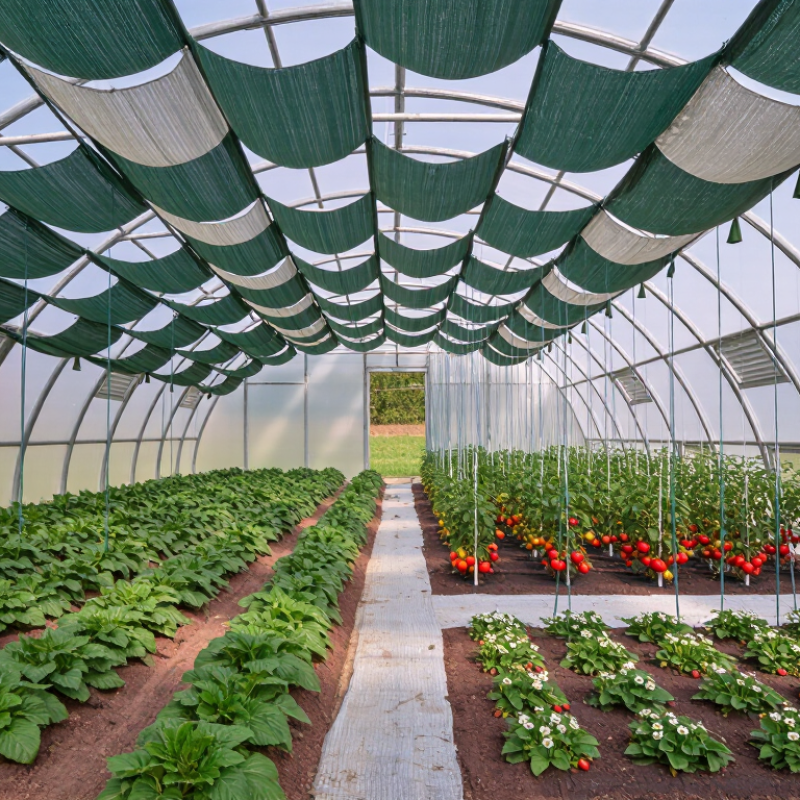
Choosing polytunnel shade netting starts with your crop’s light and heat requirements. Do not choose by net colour alone. Measure midday solar radiation, leaf temperature, and humidity inside the tunnel.
Research from Wageningen University reports that many fruiting vegetables perform best near 20–30 mol m−2 day−1 of daily light integral. Tomatoes and peppers often need strong light for flowering and fruit quality. Leafy crops usually tolerate lower levels, but excessive heat can still cause bitter leaves and bolting. The U.S. Department of Agriculture identifies temperatures above 30°C as a common stress point for several protected vegetable crops. Your local climate may require earlier shading than expected.
Match the net’s shade percentage to the crop and season. A 20% net may reduce heat while preserving useful light for tomatoes. Lettuce, spinach, and young transplants may benefit from 30–40% shading during intense summer radiation. Research published by Michigan State University notes that excessive shading can reduce plant compactness and delay crop development. That warning matters.
I once assumed darker netting meant better protection. It did not.
Check plant response after installation. Stretch a light meter beside the canopy, not near the roof. Compare morning and afternoon readings for one week. If stems become thin, reduce shading. If leaves curl by midday, increase shading or improve ventilation. A fixed net can be convenient, but seasonal adjustment is often more accurate. Data helps, though growers still need to question their first choice.
| Crop Group | Light Requirement | Main Heat Risk | Typical Shade-Net Starting Range | Useful Temperature Guide | Selection Guidance |
|---|---|---|---|---|---|
| Lettuce and other tender leafy greens | Bright light with protection from intense midday sun | Tip burn, bolting and bitter leaves during hot conditions | 30–50% | Best growth is generally around 15–22°C; growth quality declines as temperatures remain high | Use lighter shade in spring and stronger or movable shade during summer afternoons |
| Spinach and cool-season greens | Moderate to high light, but prefers cooler root and leaf temperatures | Premature flowering and reduced leaf quality | 30–40% | Optimum growth is commonly near 15–20°C | Choose moderate shade where summer temperatures regularly exceed the crop’s preferred range |
| Tomatoes | High light for flowering, fruit set and yield | Pollen sterility, blossom drop, sunscald and excessive leaf stress | 20–30% | Day temperatures around 21–27°C are commonly favorable; prolonged heat can reduce fruit set | Avoid heavy permanent shade; use ventilated, removable or retractable shade in hot periods |
| Sweet peppers and chili peppers | High light with protection from extreme radiation | Blossom drop, poor fruit set and fruit sunscald | 20–35% | Fruit set is often affected when temperatures remain above approximately 30°C | Start with light shade and increase coverage only when heat or sunscald is observed |
| Cucumbers | High light, with good air movement and balanced humidity | Leaf wilting, flower abortion and excessive greenhouse temperature | 20–35% | A daytime range near 21–29°C is commonly suitable, depending on cultivar and conditions | Use shade together with roof vents or side ventilation; shade alone cannot remove trapped hot air |
| Strawberries | Moderate to high light for flowering and fruit sweetness | Fruit sunscald, heat stress and reduced fruit firmness | 20–30% | Cooler conditions are generally preferred; sustained temperatures above approximately 25–30°C can reduce quality | Use temporary summer shade while preserving strong light during cooler flowering and fruiting periods |
| Seedlings and young transplants | Bright, filtered light; gradually increasing light is important | Leaf scorch, wilting and transplant shock | 30–50% | Exact temperature depends on the crop; avoid sudden exposure to high heat and direct sun | Reduce shade gradually as plants develop stronger leaves and roots |
| Orchids and other low-light ornamentals | Filtered light; direct intense sunlight may damage foliage | Leaf bleaching, scorch and excessive water loss | 50–70% | Many greenhouse orchids prefer warm, humid conditions but still require adequate ventilation | Select stronger shade only when the crop has genuinely low-light requirements; maintain airflow to limit disease |
| Cut flowers and light-sensitive ornamentals | Varies widely by species; most need bright but controlled light | Petal discoloration, leaf scorch and shortened vase life | 30–50% | Use the crop’s recommended temperature range rather than a single universal target | Begin with moderate shade and adjust according to leaf color, stem length, flowering and heat readings |
Start near 20% shade during bright, hot periods. Measure light beside the leaves, not near the roof. Strong light supports flowering and fruit quality. Too much shade may delay fruiting.
Try 30–40% shade during intense summer sunlight. Watch the leaves at midday. Excessive heat can cause bitterness or early flowering. Adjust gradually.
No. Dark netting can block too much useful light and become hot in direct sun. I once assumed darker meant safer. That judgment was wrong.
UV-stabilised polyethylene is lightweight and washable. Knitted fabric often handles wind better. Woven fabric feels firmer but may restrict airflow more.
White or reflective netting can reduce heat while preserving useful light. Black netting blocks light broadly and may warm. Tight weaves shade strongly but can trap moisture. Open knits usually allow more breeze.
Install it before repeated midday temperatures exceed about 30°C. Local weather may require earlier action. Check leaf temperature during the hottest hours. Do not rely on the calendar alone.
Cover a small section for seven to ten days. Record morning and afternoon light readings. Also check leaf temperature and humidity. Compare covered and uncovered plants.
Thin stems and pale leaves may indicate excessive shade. Curled leaves at midday may indicate heat stress. Improve ventilation before adding more netting. The first choice may still be wrong.
Choosing the right Polytunnel Shade Netting is essential for creating a stable growing environment and protecting crops from excessive sunlight and heat. Begin by considering the specific light requirements of your crop, as leafy greens, seedlings, flowering plants, and fruiting crops may all need different levels of shade. Local climate, seasonal temperatures, humidity, and ventilation should also guide the choice of shade density. In hot, bright regions, heavier shading may be suitable, while cooler or cloudy areas usually require lighter coverage.
When selecting netting, evaluate the material, color, durability, and weave design to ensure balanced light distribution and airflow. Measure the polytunnel carefully so the netting provides complete coverage without blocking necessary ventilation. Secure installation is important to prevent movement or damage during windy conditions. Finally, inspect the netting regularly for tears, stretching, dirt, or fading. Cleaning it when appropriate and replacing worn sections promptly will help maintain consistent crop protection and support healthy plant growth throughout the season.

 Chiyang Net